
A Diverging Diamond Interchange (DDI) is a modern interchange design where traffic temporarily crosses to the left side of the road to allow direct left turns onto freeway ramps without crossing opposing traffic. It reduces conflict points, improves left-turn capacity, and keeps vehicles moving efficiently through high-volume interchanges.
DDIs are becoming more common across Nebraska and the United States because they have been proven to significantly improve safety and reduce congestion at busy interchanges. Since the first DDI opened in 2009 (in Springfield, Mo.), more than 150 have been built nationwide, demonstrating strong public acceptance and consistent performance.
How does it work?
At a DDI, traffic is guided across the freeway overpass or underpass to the left side of the road at signalized intersections. This allows vehicles to make left turns onto freeway ramps without crossing opposing traffic. Lane markings, signage, and traffic signals direct drivers through the crossover, keeping traffic flowing safely and efficiently.
Why does it work?
A conventional diamond interchange typically has 26 potential vehicle-vehicle conflict points, where left-turning and crossing movements can increase the risk of severe crashes. A DDI reduces these conflict points to 14, which lowers the risk of severe crashes and improves overall safety. According to a study by the University of Missouri-Columbia civil engineers, DDIs reduce crashes by 40–68% and decrease total crashes by 33–48% after conversion. These safety gains come from eliminating the most dangerous movements—left turns across opposing traffic.
Because those high-risk movements are removed, DDIs also improve efficiency. Vehicles move with fewer stops, congestion decreases, and drivers benefit from better sight distances. The design accommodates heavy left-turn volumes without adding lanes.
DDI’s also operate with fewer traffic signal phases, which increase the volume of traffic able to move through the interchange and therefore decreases delay.
Benefits
Safety: DDIs reduce the potential for severe crashes by eliminating left-turn conflicts with opposing traffic. Lower conflict points and clearly marked crossings improve safety for both vehicles and pedestrians.
Efficiency: Traffic flows more smoothly through DDIs because left-turn movements no longer require stopping or crossing opposing lanes. This reduces delays, improves travel times, and lowers fuel consumption.
Increased Capacity: DDIs handle higher volumes of left-turn traffic than conventional interchanges without the need for extra lanes or complex signal phases.
Low Operation and Maintenance Costs: Once built, DDIs generally have lower ongoing costs compared to traditional signalized interchanges because fewer signal phases and simplified traffic movements reduce maintenance needs.
Aesthetics: The design allows opportunities for landscaping and lighting enhancements along the interchange and overpass areas.
Trade-Offs
High Impact: DDIs may require a larger footprint than conventional interchanges, which can affect nearby properties or require modifications to existing roads.
Driver Familiarity: While gaining popularity in Nebraska and nationwide, some drivers may be unfamiliar with the DDI layout and require time to adjust. Proper signage and markings help guide drivers through the interchange safely.
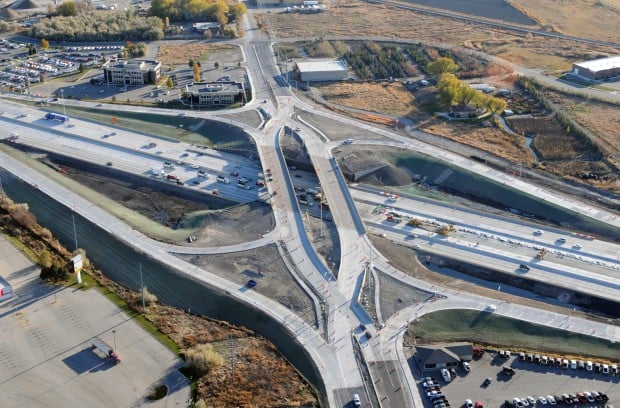
Nebraska's DDI's
The Diverging Diamond Interchange at I-80 & NW 48th Street in Lincoln (pictured) has demonstrated significant safety improvements since opening in 2016, including a 75% reduction in fatal and serious injury crashes, and 14% reduction in injury crashes.
Existing DDIs in Nebraska
Lincoln: I-80 & NW 48th Street (Constructed 2016)
Omaha: US-6 (West Dodge Rd) & 192nd Street (Constructed 2025)
Proposed DDIs (Omaha)
(Based on Metro Area Travel Improvement Study recommendations)
- I-80 & N-370
- I-80 & N-50
- I-80 & L Street
- I-680 & Pacific Street
- US-75 & Cornhusker Road
Driving a Diverging Diamond Interchange
The videos and images below provide an illustrated guide on navigating a roundabout safely and properly.